
Lesson 3: Email Marketing
Lesson Overview:
In this lesson, students will explore the strategies and best practices of email marketing. They will learn how to create effective email campaigns that engage customers, build relationships, and drive sales. The lesson will cover various types of emails, such as newsletters, promotional emails, and automated sequences. Students will also learn about email segmentation, personalization, and metrics for measuring campaign success.
Lesson Objectives
By the end of this lesson, learners will be able to:
- Understand the importance of email marketing in e-commerce.
- Create and manage different types of email campaigns.
- Segment and personalize email lists for targeted marketing.
- Measure the success of email marketing efforts using key metrics.
Introduction
Welcome to “Email Marketing,” the third lesson in our module on Digital Marketing Strategies. Email marketing is a powerful tool for e-commerce businesses, offering a direct and personalized way to communicate with customers. In this lesson, we will explore the various types of email campaigns, strategies for segmentation and personalization, and best practices for creating compelling emails. We will also discuss how to measure and optimize your email marketing efforts. Let’s dive into the world.
Email marketing refers to the practice of using email to promote products, services, and engage with current and potential customers. It is a powerful tool for businesses of all sizes to drive customer acquisition, retention, and increase their overall revenue.
Why is Email Marketing Important?
Email marketing provides several advantages over traditional marketing channels. Firstly, it allows businesses to directly connect with their target audience. By sending personalized and targeted emails, businesses can establish a strong communication channel, build brand loyalty, and enhance customer relationships.
Secondly, email marketing is cost-effective and provides a high return on investment. Compared to other marketing tactics, such as print advertisements, radio, or television, email marketing is significantly cheaper and can yield better results in terms of engagement and conversions.
Thirdly, email marketing enables businesses to measure and track their campaign performance. By analyzing key metrics such as open rates, click-through rates, and conversion rates, businesses can gain insights into the effectiveness of their email marketing strategies and make data-driven decisions to optimize future campaigns.
Disadvantages of email marketing
While email marketing seems like the perfect way to reach out to customers, create new prospects, and grow important business relationships, there are some drawbacks. In fact, many businesses are opting to use EZ Texting as another form of communication.
Here are some of the significant downsides to email marketing campaigns.
- Spam. It seems like our inboxes are filled with worthless information. “Lose 25 pounds in two weeks,” “Click here for a big discount.” We all get them and nearly instantly hit delete. In addition, we never even see many of these emails because they end up in our junk or spam folders. Unless you are actively avoiding spam filters, these messages are often just a waste of time for the company that sent them.
- Size. If your email is too large, it might take a long time to load—or even not load at all. In that time it takes to download, a potential customer has just lost interest, costing you business.
- Competition. Disadvantages aside, email marketing is a popular form of marketing, which means that your email isn’t going to be the only one flooding users’ inboxes. This means that to stand out from competitors, you might need to invest in strong copywriters or offer additional promotions to capture your audience’s attention.
- Engagement. Frequently, a customer sees an ad and signs up for emails based on that 1 instance or offer. They may or may not use it. In any case, they are now in the clients’ database, but that doesn’t mean they will keep opening up your emails and clicking through to your site. You have to continuously find ways to engage your audience, or you might find yourself with high unopened rates or a lot of people unsubscribing.
Email Marketing types and Examples
There are many different types of email marketing. Each one serves a different purpose and takes a different avenue to engage with your audience. We are going to look at some of the many different types, so you can create the best email marketing campaign for your company.
1. Welcome emails
This type of email welcomes customers and encourages them to learn more about your product or service. They often offer a trial or other bonus. It is used to introduce a potential new customer to the business.
2. Newsletter emails
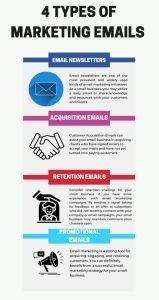
Newsletter emails are very popular, and they often highlight new products and services. They may also include articles, blogs, and customer reviews. Usually, there will be a call to action to move the reader to do something, whether that is reading a new blog post or checking out a new
product.
3. Lead nurturing emails
This type of email targets a specific audience through a series of emails in the hope of eventually converting them. Typically, lead nurturing emails focus on a group that is interested in a specific product or service and then build their interest through more emails that offer additional information or relevant promotions. The goal is to push users from the consideration stage to the purchasing stage.
4. Confirmation emails
Those that have recently signed up for emails or newsletters, or have purchased an item online for the first time may get a confirmation email. This ensures the prospect that the information has been received and they are on the list to receive additional information. These are also a way to let users know that their purchase has been received or that their sign-up was successful and can include more actions for them to take.
5. Dedicated emails
If you want to reach out to only a portion of your email list, this is called a dedicated email. Its list may be based on recent purchases, inactive clients, new members, and other specific types of criteria.
6. Invite emails
These types of emails often announce upcoming events,
new pro
duct launches, and seminars. Most companies use these types of emails when there is something special going on to gain attention and increase awareness about special events.
Key Components Email Marketing
There are many different types of email marketing. Each one serves a different purpose and takes a different avenue to engage with your audience. We are going to look at some of the many different types, so you can create the best email marketing campaign for your company.
- Email List Building
Building an email list is a crucial first step in email marketing. To start, businesses need to gather email addresses from people who have consented to receive marketing emails. This can be done by implementing sign-up forms, lead magnets, or offering incentives to encourage website visitors, customers, and prospects to subscribe to the email list.
- Email Segmentation and Personalization
Segmentation involves dividing your email list into smaller, targeted groups based on specific criteria such as demographics, purchase history, or engagement. By segmenting your list, you can tailor your email content to resonate with each group’s unique preferences, increasing the likelihood of engagement and conversions.
Personalization goes hand-in-hand with segmentation. It involves using customer data to create personalized email messages that address each recipient by name and provide relevant content based on their interests and behaviors. Personalization helps in creating a more meaningful and engaging experience for the recipients.
- Email Design and Content
The design and content of your emails play a critical role in grabbing attention and driving engagement. Emails should be visually appealing, mobile-friendly, and include a clear call-to-action. Email content should be concise, relevant, and provide value to the recipients. It is essential to strike a balance between promotional content and informative or educational content to avoid overwhelming subscribers with sales-driven emails.
- Email Automation and Drip Campaigns
Email automation refers to the use of automation tools to send targeted emails to subscribers based on specific triggers or predefined schedules. Drip campaigns, a form of email automation, involve sending a series of pre-written emails over a specific period. Automation and drip campaigns help in nurturing leads, onboarding new customers, and re-engaging dormant subscribers, all without requiring manual intervention
- Email Testing and Analytics
Testing different elements of your email campaigns is crucial for optimizing their performance. A/B testing allows you to compare different versions of an email to determine which elements, such as subject lines, images, or call-to-action buttons, drive better results. Additionally, analyzing email analytics provides valuable insights into how subscribers interact with your emails, enabling you to continually refine and improve your email marketing strategy
Creating Effective Email Campaigns:
- Define Goals: Clearly outline the objectives of your email campaign (e.g., increase sales, boost engagement).
- Craft Compelling Subject Lines: Write attention-grabbing subject lines that encourage recipients to open the email.
- Personalize Content: Use recipient’s name, preferences, and past behavior to tailor the email content.
- Include Clear Calls-to-Action (CTAs): Use prominent and compelling CTAs to guide recipients towards the desired action.
- Design for Mobile: Ensure emails are mobile-friendly, as many users read emails on their mobile devices.
- Test and Optimize: A/B test different elements of your emails (subject lines, CTAs, content) to determine what works best.
Segmenting and Personalizing Email Lists:
- Segmentation: Divide your email list into smaller segments based on criteria such as demographics, behavior, and purchase history.
- Personalization: Customize emails for each segment to increase relevance and engagement.
- Dynamic Content: Use dynamic content blocks to display different content to different segments within the same email.
- Behavioral Triggers: Send emails based on user actions, such as abandoned cart reminders or product recommendations.
Measuring Email Marketing Success:
- Open Rate: The percentage of recipients who open your email.
- Click-Through Rate (CTR): The percentage of recipients who click on links within your email.
- Conversion Rate: The percentage of recipients who take the desired action after clicking through your email.
- Bounce Rate: The percentage of emails that could not be delivered to recipients.
- Unsubscribe Rate: The percentage of recipients who unsubscribe from your email list.
- Return on Investment (ROI): Measure the overall profitability of your email campaigns by comparing the revenue generated to the cost of the campaign.
Lesson Summary
In this lesson, we explored the fundamentals of email marketing. We discussed the importance of email marketing in e-commerce, various types of email campaigns, and strategies for creating effective emails. We also covered segmentation and personalization techniques to enhance the relevance and engagement of email campaigns. Finally, we examined key metrics for measuring the success of email marketing efforts. By applying these strategies and best practices, you can harness the power of email marketing to drive customer engagement and boost sales.